


From sight to science
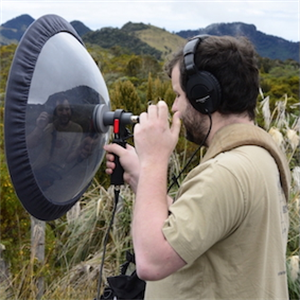
Juan Pablo Culasso, Culasso, an innate audio designer living in Colombia, has completed three thousand audio recordings of over 700 birds in a wide geography ranging from Brazil to Antarctica. Culasso, especially known for working in environmental protection areas in various regions of South America, creating archives for visual disabilities by recording sounds in nature, helps these sounds to move to the future. Culasso’s voice recordings, documentary, eco-acustic researches and accessible tourism activities that collaborate with many important organizations including Cornell University.
Among 50 people who change the world
] [[T]] Juan Pablo Culasso was awarded the ‘Colombia Riqueza Natural’ award with the routes developed to observe birds of sight disabilities in Colombia. Culasso, the winner of National Geographic’s ‘Supercerebros’ (Super Brains) competition, was shown among 50 people who had to be recognized by Kasifler Club, aiming to promote scientific exploration and field studies in the last year. Culasso aims to make the most known work visible sounds of nature with ‘Sonidos Invisibles’ (Non-Visible Sounds) and to make people look deeper bonds with nature. Culasso’s voice records from nature meet listeners in various digital platforms. [
[
"I noticed that you can turn on a way of life"
] Juan Pablo Culasso says that it learned to detect the world since childhood and is a form of nevi vision for it. I started to learn when one of the milestones in life is met with music in small ages, Culasso, "I began to learn bird sounds from CDs and tapes while I had 16 years old. When I received my first audio recording device, I noticed that the sound can turn into a way of life for me. Culasso says that it is a milestone in the life of winning the Super Brains competition, making it possible to take advantage of its work in the international area.
No more comprehensive collection has been published
Juan Pablo Culasso, which explains that the voice of the baby is often invisible and the appearance of the Invisible Sounds project, which is ignored as background noise, says: "I wanted to pay attention that every voice is meaning and the ecosystem health is an indicator. The project’s name reflects both the visual impairment and the sound landscapes that are not visible. As a result of my studies, I published more than twenty comprehensive collections of audio guides and natural media sounds for regions such as Pantanal, Atlantic Forests, Colombia, Uruguay, Argentina and Antarctica. "
]
" weather conditions make things more difficult"
] Juan Pablo Culasso states that it fights many problems that may not be pre-expected when seeing wildlife, "Sometimes may not even be heard of a single voice. Weather conditions, loss of living space and human-source noise, make things more difficult." As one of the visual disabilities, Culasso tells you that moving in dense and rugged terrain creates logistic challenges, thanks to its advanced listening ability to capture subtle sound patterns that others can’t notice. Culasso was very meaningful for me to record sounds of rare and mysterious species, such as Harpy card and chestnut bushy in Colombia, expressing that it is an unforgettable experience to encounter some animals that are very rare. It was like to travel back at the time of menstruation. To capture these sounds, it once again showed why it is important to protect the self of living natural life. Culasso, saying that a live recorded voice will be like to lose one that knows about the depletion of the nesli, so it is very important to protect the sounds that are recorded.
]
"A indicator of the crash of the loss ecosystem of rats"
Juan Pablo Culasso is complemented by highlighting that natural life protection efforts should be increased: "Protection should be integrated into the forms of building cities, economies and infrastructures of societies. The protection of living spaces is vital. Because the loss of sounds is a indicator of the crash of the ecosystem. We also need to promote experiential protection. In this way, we can avoid the alienation from it by connecting people with nature. "
Among 50 people who change the world
] [[T]] Juan Pablo Culasso was awarded the ‘Colombia Riqueza Natural’ award with the routes developed to observe birds of sight disabilities in Colombia. Culasso, the winner of National Geographic’s ‘Supercerebros’ (Super Brains) competition, was shown among 50 people who had to be recognized by Kasifler Club, aiming to promote scientific exploration and field studies in the last year. Culasso aims to make the most known work visible sounds of nature with ‘Sonidos Invisibles’ (Non-Visible Sounds) and to make people look deeper bonds with nature. Culasso’s voice records from nature meet listeners in various digital platforms. [
[
"I noticed that you can turn on a way of life"
] Juan Pablo Culasso says that it learned to detect the world since childhood and is a form of nevi vision for it. I started to learn when one of the milestones in life is met with music in small ages, Culasso, "I began to learn bird sounds from CDs and tapes while I had 16 years old. When I received my first audio recording device, I noticed that the sound can turn into a way of life for me. Culasso says that it is a milestone in the life of winning the Super Brains competition, making it possible to take advantage of its work in the international area.
No more comprehensive collection has been published
Juan Pablo Culasso, which explains that the voice of the baby is often invisible and the appearance of the Invisible Sounds project, which is ignored as background noise, says: "I wanted to pay attention that every voice is meaning and the ecosystem health is an indicator. The project’s name reflects both the visual impairment and the sound landscapes that are not visible. As a result of my studies, I published more than twenty comprehensive collections of audio guides and natural media sounds for regions such as Pantanal, Atlantic Forests, Colombia, Uruguay, Argentina and Antarctica. "
]
" weather conditions make things more difficult"
] Juan Pablo Culasso states that it fights many problems that may not be pre-expected when seeing wildlife, "Sometimes may not even be heard of a single voice. Weather conditions, loss of living space and human-source noise, make things more difficult." As one of the visual disabilities, Culasso tells you that moving in dense and rugged terrain creates logistic challenges, thanks to its advanced listening ability to capture subtle sound patterns that others can’t notice. Culasso was very meaningful for me to record sounds of rare and mysterious species, such as Harpy card and chestnut bushy in Colombia, expressing that it is an unforgettable experience to encounter some animals that are very rare. It was like to travel back at the time of menstruation. To capture these sounds, it once again showed why it is important to protect the self of living natural life. Culasso, saying that a live recorded voice will be like to lose one that knows about the depletion of the nesli, so it is very important to protect the sounds that are recorded.
]
"A indicator of the crash of the loss ecosystem of rats"
Juan Pablo Culasso is complemented by highlighting that natural life protection efforts should be increased: "Protection should be integrated into the forms of building cities, economies and infrastructures of societies. The protection of living spaces is vital. Because the loss of sounds is a indicator of the crash of the ecosystem. We also need to promote experiential protection. In this way, we can avoid the alienation from it by connecting people with nature. "
Source: Announcements