


COP29: See the third day Tags
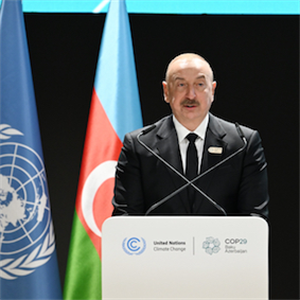
Significant advances on the third day of the COP29 Climate Summit held in Baku, climate finance, emission reduction targets and energy conversion. Countries participating in the Summit have created the main titles of the day with critical environmental problems such as the role of nuclear energy, the responsibility of financing of developed countries and soil loss, while relevance the financing needs to limit global warming. In the peak of many important explanations from Turkey to Brazil, from Azerbaijan to new countries that support nuclear energy, new targets and collaboration calls were highlighted in the fight against climate change.
New Collective Nicel Target (NCQG) Climate funding discussions with draft
]
On the third day of COP29, the new Kolektif Nicel Target (NCQG) draft for climate financing was staged to intense negotiations. The emerging countries claim that the current 100 billion dollar annual financing goal is no longer insufficient, rapidly increasing climate change needs to be removed from 1,3 to 2 trillion dollars annually. Draft text contains 34 pages long and a large number of options, which shows that the countries protect their existing positions, and the one is not provided yet. Arjun Dutt from Energy, Environment and Water Council stressed that NCQG should be developed with a proven approach, reflecting the needs of developing countries. Experts indicate that the final decision on this will be resolved with the political will. [
High Target Coalition call for innovative climate financing [
Another development that pays attention to COP29 was the explanation of the High Iddiali Coalition, which includes some of the G7 countries. Coalition expressed that trilyons need to be lost in order to overcome the climate crisis and to fulfill the financing commitments of advanced countries. This coalition, which includes G7 members such as Canada, France, Germany and the Netherlands, stressed the importance of commissioning innovative financing solutions. In the statement, the developed countries must continue the leadership of climate financing, which indicates that the developed countries must take greater responsibility to achieve global climate targets.
The ambitious emission target with the updated National Declaration of Additive (NDC)
]In COP29, Brazil revealed its stability in the fight against climate crisis with the updated National Declaration of Additive to the United Nations. The new commitment states that Brazil targets to reduce carbon dioxide emissions by 59 to 67 percent compared to 2005. This assertive goal shows that Brazil wants to take a more effective role in fighting climate change in line with the Paris Agreement. This new commitment of the country is considered a step that constitutes an example in the global fight against climate crisis.
Enjoying energy three times: six new countries joined more
]
On the third day of COP29, the nuclear energy capacity has announced that six countries have joined more declarations in line with the goal of tripled up to 2050. This development was announced by the joint event of the US and the World Nuclear Union. General Director of the World Nuclear Association Dr. Sama Bilbao y León noted that the participation of new countries strengthened its critical role in achieving global energy safety and climate targets. The U.S. government continued its support for nuclear energy by explaining that it plans to activate 200 gigavat nuclear capacity by 2050.
[
Turkey’s Long-term Climate Strategy and Output Target from Fosil Fuels
]
Minister of Environment, Urbanization and Climate Change in Turkey Murat Corporation announced the strategy of Long Term Climate Change, which includes a clear zero carbon target for 2053 of Turkey in COP29. According to the strategy, Turkey aims to provide 50 percent of energy production up to 2053 percent of renewable energy and 30 percent of its nuclear energy sources. However, there was no clear date on the exit from fossil fuels. The Minister Institution gave the signal to take steps in this direction by saying “We will be out of fossil fuels in time”.
The Call of the Business Union on the Effects of Bulk Loss Crisis and Climate Change
]
The Minister of Agriculture of Azerbaijan Majun Mammadov stated that at a round table meeting held in COP29, about 40 percent of the world’s lands were broken and this crisis threatens ecosystems, food safety and water resources. Minister highlighted digital transformation, technology transfer and joint work necessity to reduce negative effects on the agricultural sector of climate change. Mammadov expressed that the state support is provided for the development of climate-friendly systems in agriculture in Azerbaijan and the modern irrigation systems of farmers are encouraged for innovative applications such as soil efficiency enhancing projects. [email protected]
Source: Climate Change